
Odoo MRP helps manufacturers plan which materials are needed, in what quantities and at what point in the production process. It links planned production with Bills of Materials, available inventory and lead times. This makes it possible to identify potential shortages before production starts and address them early.
Imagine that a delivery date has already been agreed with a customer, but when the order is prepared for production, the team discovers that one required component is unavailable. Other materials may have been sitting in stock for some time, but without the missing part the order still cannot be completed. The company then has to revise the plan, source the missing component urgently and potentially renegotiate the delivery date.
The purpose of Odoo MRP is to help identify this type of shortage during planning, rather than only when production is about to begin.
MRP stands for Material Requirements Planning. MRP calculations are based on what needs to be produced, which components make up the product and what inventory is available. Odoo MRP brings this information together to support material planning.
A simple hypothetical example illustrates the principle.
A company needs to manufacture 100 units of a product, with four identical components required for each unit. The total requirement is therefore 400 components.
If 150 components are already available in stock and another 100 are due to arrive before production starts, the company still needs 150 additional components. However, if the planned delivery arrives too late, the shortage at the planned production start date will be greater.
In practice, the calculation is more complex. The same component may be used in several products, some inventory may already be allocated to other orders, and certain subassemblies may need to be manufactured first. This is why simply looking at total stock on hand is not enough. The planner also needs to understand which orders or production requirements that stock is already allocated to, and when it will actually be available.
If an order quantity or delivery date changes, material requirements need to be reassessed. When product structures, orders and inventory are managed in separate spreadsheets, the planner has to check each related source manually. Keeping this information in one system makes it easier to reassess requirements consistently, but only if the data is kept up to date.
The planner also needs to understand why the shortage occurred. A shortage caused by an increase in a customer order may require a different response from one caused by a supplier delay. In one case, an additional purchase may be required. In the other, the company may need to adjust the delivery date or change the production sequence.
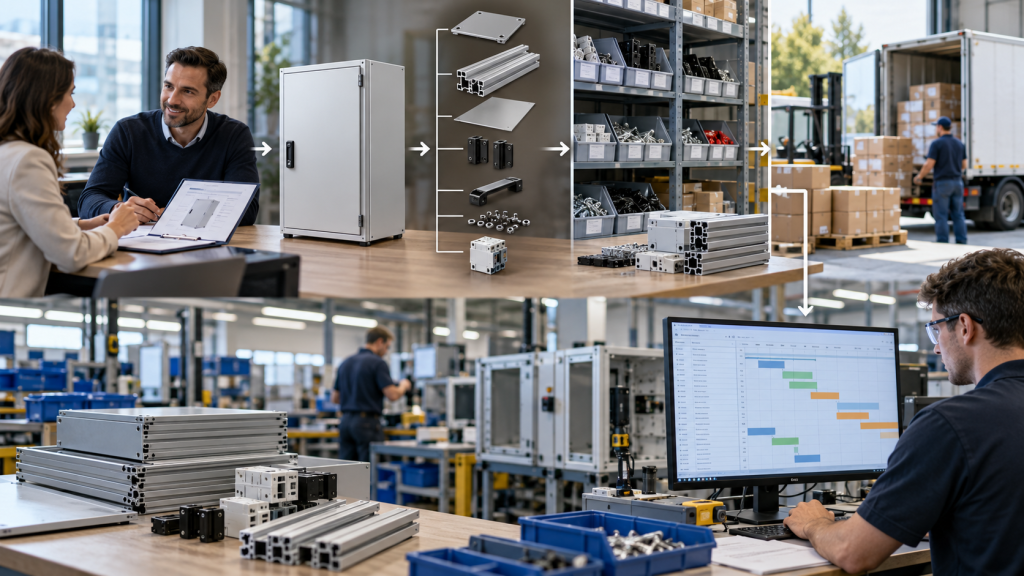
Odoo MRP focuses primarily on what materials production will require and when they need to be available.
ERP, or Enterprise Resource Planning, covers a broader range of business processes, such as sales, purchasing, inventory, finance and other operational areas. MRP can form part of the wider ERP system.
For example, a sales order may create demand for production. Fulfilling that demand may require additional raw materials, which in turn creates a purchasing requirement. Once the materials are received, inventory changes, while the supplier invoice flows into accounting.
An ERP system can link these activities so that different departments work with information that is consistent across the process.
This is why, when choosing a solution, it is useful to ask where information stops flowing reliably between processes. Perhaps the main challenge is calculating material requirements. Or perhaps the planner receives the correct figures too late because sales and warehouse teams work separately.
In that case, improving MRP alone will not solve the problem. The links between those processes also need to be considered.
In Odoo, the structure of a product is defined using a Bill of Materials, or BoM. This specifies the components and quantities required, while work orders can be used to define the individual operations required to manufacture it.
A manufacturing order defines what needs to be produced and in what quantity. Work orders can break the process into individual operations, such as cutting and assembly. These operations can then be assigned to work centres where the relevant tasks are carried out.
This links production planning to specific operations and the work centres responsible for carrying them out.
If one operation can only begin after another has been completed, Odoo allows dependencies to be defined between them. This matters, for example, when assembly cannot start until the required parts have been prepared.
During planning, it is therefore possible to consider both the sequence of work and the load on individual work centres.
Material availability and production capacity, however, are two separate questions.
All required components may be available in stock, but the machine needed for the next operation may already be fully occupied. This is why an implementation needs to account separately for supplier lead times, operation durations and available capacity.
Defining a target production date alone is not enough to account for all of these constraints.
In practice, it is useful to test the setup using several of the company’s actual products. One may have a simple product structure, another may include several levels of subassemblies, while a third may depend on an operation performed at a work centre with limited capacity.
These examples help determine which settings are actually required.
In serial manufacturing, products, Bills of Materials and operations tend to repeat.
The main challenge is often to coordinate demand across different orders, account for shared components and understand how a change in the quantity of one production batch will affect other planned work.
A standardised Bill of Materials provides a reliable basis for planning, but it still needs to be updated whenever the product changes.
Project-based manufacturing usually involves more individual variation.
One order may require different dimensions, another an additional component, and another a different sequence of operations. Material planning remains useful, but the company needs to agree when the product structure is sufficiently finalised for purchasing and production to proceed, and who is responsible for recording later changes.
If a revised specification remains only in an engineer’s file, the planner may order materials using the previous version.
Software alone will not solve this kind of problem. The company also needs a clear process for ensuring that changes reach the people who depend on them.
Whether MRP is needed depends largely on the complexity of the company’s production processes.
A small number of products may be manageable with relatively simple tools. But as the number of shared components, production orders and changes increases, manual coordination requires more and more time.
It is worth looking not only at how much time is spent building the plan itself, but also at how much time is spent finding, checking and reconciling the information needed to create it.
The first step is to review the company’s Bills of Materials.
Are component quantities correct? Are finished products and subassemblies clearly distinguished? Do employees know which version of a product structure is currently used in production?
Any error at this stage will affect the material requirements calculated by the system.
The next step is to review inventory and lead-time data.
Stock shown in the system should reflect recorded inventory movements, while supplier lead times should reflect how long suppliers actually take to deliver. It is also worth discussing exceptions in advance, such as partial deliveries, missing components or urgent orders that require the production sequence to be changed.
Clear ownership is equally important.
Who updates the Bill of Materials? Who records material consumption? Who reviews the production plan when a delivery date changes?
These questions are better resolved before go-live, while the full order process can still be tested and unclear areas can be identified.
If you want to see how material requirements and production planning can work together with the rest of your business processes, take a look at our page on ERP for manufacturing companies.
A conversation with Sandas can start with a single real production order: what information do you currently have to gather before you can plan it with confidence?
Gaukite naujienas ir pasiūlymus el. paštu.